
The Dining Room Sets the Tone for an Assisted Living Tour
A family touring an assisted living home is not really touring a building. They are trying to picture their mother eating lunch there every day, their father spending his afternoons there, their loved one living inside rooms that someone else is responsible for keeping. It is one of the most emotional decisions a family makes, and it often happens under pressure, after a fall, a hospital stay, or a quiet realization that home is no longer safe enough on its own. That pressure makes families watchful in a way ordinary customers are not. In Los Angeles County and San Bernardino County, adult children walk in already feeling guilt, worry, and a need to get this choice right. They listen to what your team says about care, activities, and meals. Then they look at the common areas and the dining room, and they believe what those rooms tell them, because rooms do not rehearse a sales pitch. A worn common area, a dining room floor that has lost its shine, chairs with stained arms, and a faint odor nobody on staff notices anymore do not read as small housekeeping details to a visiting family. They read as a preview. If this is how the public rooms look when a tour was expected, the family quietly wonders how the private rooms look on an ordinary Tuesday, and how carefully their loved one will be looked after when no visitor is coming.
The First Ten Minutes Carry the Whole Visit
Operators in senior living hear the same story again and again. A home offers attentive care and a warm staff, and still loses a family somewhere on the first walk through. Supplyline Medical, writing about what families notice during facility tours, reports that most decision makers form an impression within the first ten minutes, and that more than eighty percent cite cleanliness and appearance among their top decision factors. The tour does not fail at the pricing conversation. It fails in the lobby, along the hallway, and at the entrance to the dining room. That timing matters because first impressions are hard to reverse. A daughter who registers worn upholstery, dusty corners, and a dining room that feels tired in the first few minutes spends the rest of the visit looking for confirmation of what she already fears. She notices the handrail, the restroom visitors are directed to, and the baseboards in a way she never would have if the opening rooms had felt cared for. A son who feels calm in a bright, fresh common area gives the rest of the tour the benefit of the doubt. The building itself sets the terms for every conversation that follows.
The Dining Room Is Where Families Picture Daily Life
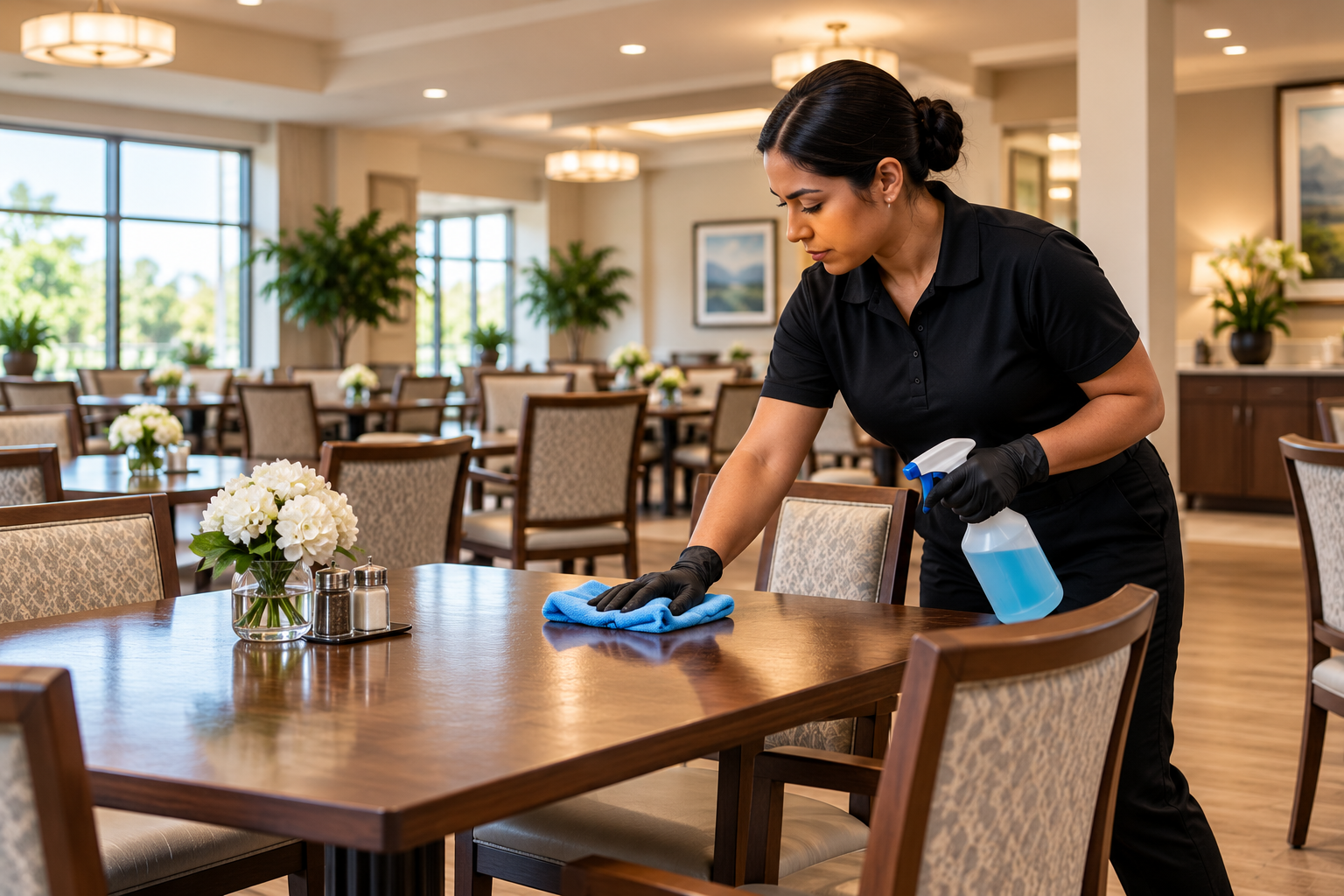
Families can imagine many parts of assisted living only in the abstract, but everyone understands a dining room. Three meals a day happen there. Birthdays happen there. Residents gather, linger, and build whatever social life the home makes possible. When a family stands in that doorway, they are not evaluating a cafeteria. They are asking whether their parent will feel dignity in that room, whether they themselves will feel comfortable joining a holiday meal there, and whether the people who run the home take ordinary daily life seriously. That is why wear in a dining room lands so hard. Tables that feel sticky, floors darkened along the serving path, chairs that look tired from years of use, and windows that have gone dull all suggest that the most repeated ritual of the day happens in a room nobody is truly tending. Seniorly, in its Resident Sentiment Report drawn from hundreds of thousands of senior living reviews, found cleanliness surfacing in roughly a quarter of all resident and family sentiment, and tied odor and cleanliness closely to how families judge overall quality. Families may arrive saying their priorities are care levels and location. The reviews they later write tell a different story about what stayed with them. The dining room also carries the residents themselves into the judgment. Visiting families watch how current residents look and how the room feels around them. A common area that smells stale or looks neglected makes a family wonder whether the people living here are surrounded by fading standards, and whether their own loved one would slowly become part of that picture.
Common Areas Never Get a Day Off
An office lobby empties at night and resets by morning. An assisted living common area does not work that way. It is in use from early morning until late evening, every day, by residents with walkers and wheelchairs, by staff moving between tasks, by visiting families, delivery drivers, and care providers coming and going. The same chairs are sat in for hours. The same handrails, elevator buttons, door handles, and restroom surfaces are touched again and again by many hands, including hands that are frailer and more vulnerable than most. That constant use is also why infection is not an abstract concern in this setting. The Association for Professionals in Infection Control and Epidemiology, in its long term care guidance, notes that nearly one million people reside in assisted living facilities in the United States, that people living closely together are more likely to pass infections to one another, and that bacteria and viruses including MRSA, C. diff, and norovirus are among those that move through long term care settings. The Centers for Disease Control and Prevention, in its environmental infection control recommendations for health care facilities, calls for high touch surfaces to be cleaned and disinfected on a more frequent schedule than surfaces people rarely touch, precisely because shared contact is where risk concentrates. A family on a tour does not know those citations, and they do not need to. They see a common room that looks worn and they feel the risk in plain terms. Their parent has a weaker immune system than they did ten years ago. A cold that moves through a shared living room is not a minor event at that age, and a stomach illness moving through a shared dining room can close the very spaces that make the home feel like a home. Cleanliness in this setting is not about appearances competing with care. To families, cleanliness is care, made visible.
Staff Stop Seeing the Wear That Families See Instantly
The people who work in a home walk the same hallways dozens of times a day, and familiarity does what it always does. A scuff becomes part of the wall. A chair that faded over two years still looks like the chair it has always been. A faint odor in a common area disappears for the people who are in it all day, while it is the first thing a visiting daughter notices when the door opens. None of that means the staff cares less. It means gradual decline is invisible to the people closest to it, and glaring to the people deciding whether to trust the home with their parent. Care staff are also pulled toward urgent human needs all day long, and rightly so. A resident needs help, a medication window opens, a family member calls with a worry. In that kind of day, the common areas become background, tended in the gaps, and the gaps keep shrinking. The result is a home where the care itself may be genuine and the rooms quietly argue otherwise, day after day, tour after tour, to the very families the home most needs to convince.
The Lasting Impression of Shared Spaces
Almost no family leaves a tour and says they chose another home because the dining room looked worn. They say the other place felt better, felt brighter, felt more like somewhere they could picture their mother. They tell their siblings it just did not feel right. Operators hear those soft explanations and adjust their pricing, their activities calendar, or their tour script, while the real reason sits in the common area furniture and the dining room floor, unchanged for the next family. Current residents and their families carry the same impression forward. Visiting relatives who see tired shared spaces week after week become the people who write reviews, raise concerns at care meetings, and quietly start asking friends about other homes. In a region as connected as the San Fernando Valley, the Inland Empire, and the communities across Los Angeles County, reputation travels through exactly those conversations. When a home reaches the point where its common areas and dining room need steadier attention than a care team can give them between the real work of looking after residents, many operators end up talking with Paradigm Janitorial about the commercial spaces their families judge them by. Your caregivers should be free to be seen doing what families came hoping to see, caring for people. The rooms those families walk through should not be quietly making the opposite case.
Sources and references
https://infectionpreventionandyou.org/settings-of-care/long-term-care/
https://www.cdc.gov/infection-control/hcp/environmental-control/recommendations.html