
Your Bakery Case Can Sparkle While the Floor Under the Counter Tells Another Story
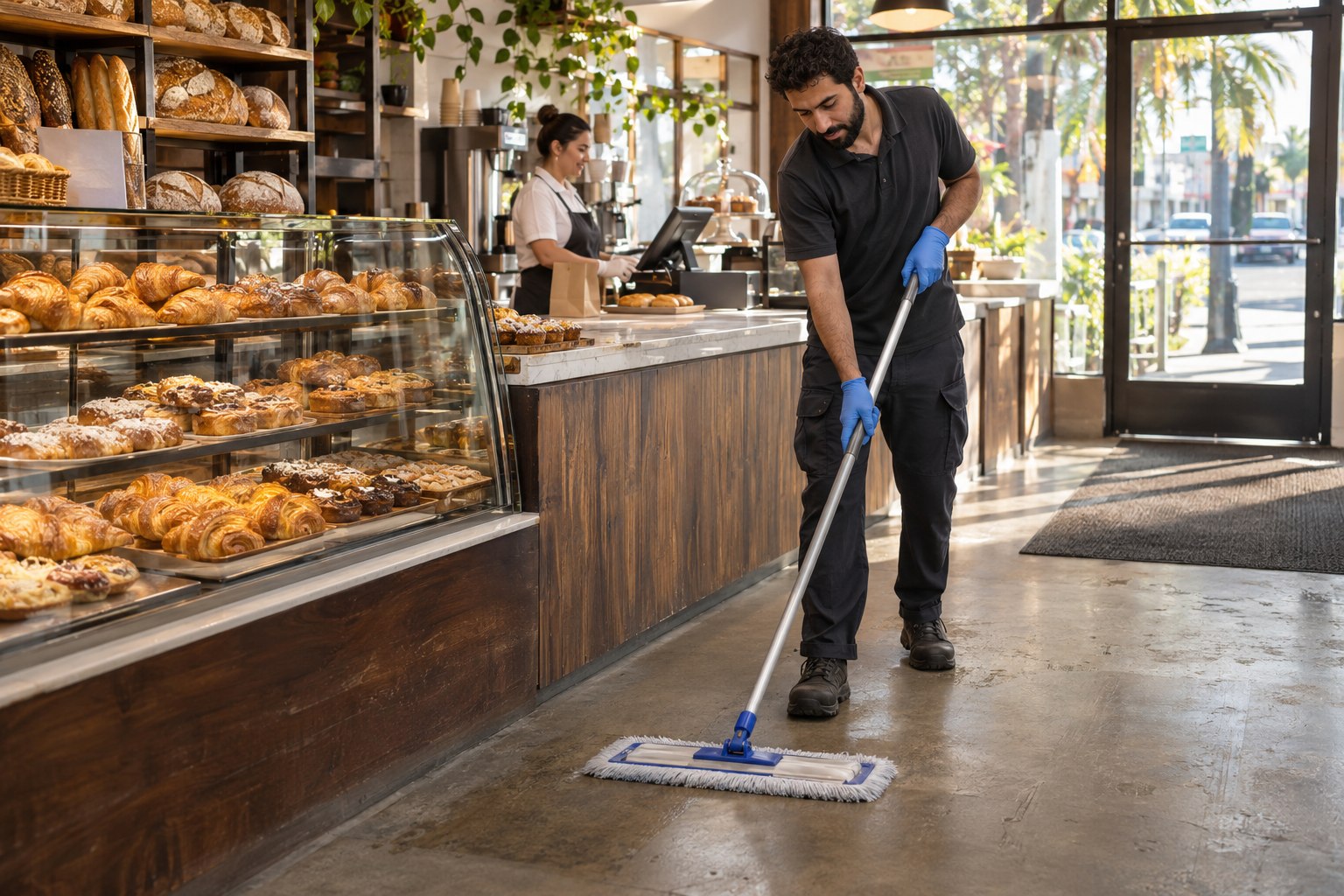
The case is the first thing a bakery does right, and most bakeries know it. The glass is clear, the light inside is warm, the rows are neat, and the pastries look like the best version of the morning. A customer leans in, the way customers do, close enough that her breath nearly fogs the glass, deciding between two things she wants equally. It is the moment the whole shop was built around, and for those few seconds, the bakery is exactly what it hopes to be.
Then she steps back, looks down to find her footing in line, and sees the floor.
It is not a disaster. That is what makes it so easy to live with. It is a floor that carries the morning in it, tracked in from the entry, dulled along the path every customer walks, sticky in the vague neighborhood of the drink station, tired under the counter where she is about to pay. The entry mat holds the weather of a Los Angeles County morning, and in the wetter weeks, the start of the rainy season that reaches into San Bernardino County too. The restroom, when she visits it before leaving, will either confirm the case or contradict the floor, and regulars know which bakeries land on which side of that line without ever saying it out loud.
A bakery asks to be judged on care. It sells things made by hand, early, with attention, and customers happily pay for that attention. The floor under the counter is where that claim gets tested by eyes that were not looking to test it at all.
Customers read a food shop from the floor up, whether they mean to or not
People are generous interpreters of a beautiful display and strict interpreters of everything around it, because the display is understood to be presented. Of course the case sparkles. It is supposed to. The floor, the entry, and the restroom are not presented, and that is exactly why customers trust them as evidence. They feel like the unedited version of the business, the part that shows how the shop is run when it is not performing its best trick.
Research on food businesses keeps measuring how heavily that evidence weighs. A Cintas survey conducted by Harris Poll and reported by CleanLink found that 86 percent of diners named dirty surfaces as a factor that would keep them from returning to a restaurant, 80 percent named dirty restrooms, and 72 percent named dirty or slippery floors. Other Harris Poll findings reported in restroom industry coverage put it in kitchen terms customers understand instinctively, with a large share of people saying a dirty restroom reflects poorly on the kitchen and food preparation areas behind it.
A bakery lives closer to that instinct than almost any other food business, because so much of what it sells sits out in the open, under glass, at eye level, inviting inspection. A customer who is invited to inspect the product this closely does not stop inspecting at the edge of the case. The same closeness that sells a croissant sends her eyes to the floor it stands over, and the conclusion she reaches down there attaches itself to the food up here.
The line gives customers time to notice, and regulars notice in layers
A bakery line is a particular kind of captivity. It moves slowly, it faces the counter, and it gives a person little to do but look around the shop she is standing in. First time visitors look at the menu and the case. Regulars, who already know both, look at everything else. They have stood on that floor a hundred mornings. They know how it felt in September and they can feel, without ever putting it into words, that it feels different now, heavier, duller, a little less like the shop they chose as theirs.
That slow change in how regulars feel is the quiet cost. A bakery rarely loses its morning crowd in an argument. It loses it in drift, one customer at a time deciding the coffee place two streets over feels fresher, without being able to name why, and without the bakery ever hearing a complaint it could answer. New shops understand this instinctively and fear it. Older, loved shops are more exposed to it, because love buys forgiveness for a long while, and forgiveness lets a floor go a long while too, until the forgiveness runs thinner than anyone noticed.
The staff experience runs parallel. The people behind the counter stand on that floor for whole shifts. They see the entry at its worst on a wet morning and the restroom at its worst on a busy Saturday, and they absorb the same message customers do about how much the details of this place are anyone concern, whether or not anyone ever says so.
What a bakery cleaning schedule should cover
Bakery managers should separate customer facing presentation from the cleaning required behind the scenes. High traffic entrances, beverage stations, restroom touchpoints and flooring need attention during the day, while suitable deeper tasks may be scheduled outside busy service hours.
Use cleaning methods compatible with the premises and food service requirements. Commercial janitorial work must be coordinated with the business sanitation procedures. Do not assume a general cleaner is responsible for food contact sanitation unless the scope specifically includes it.
During a walkthrough, identify floor surfaces, spill patterns, safe access times and whether entry mats, waste bins or restroom servicing need more frequent attention. Those details make a cleaning proposal more useful than a generic promise to keep the bakery spotless.
Morning rush hours do to a bakery what they do to no other shop
Everything about a bakery conspires against its floors. The day starts before dawn and peaks hard and early. Deliveries come through the same entry customers use. The first rush arrives with school runs and commutes, bringing in wet shoes, stroller wheels, and the grit of the street, all of it ground into the busiest square of flooring in the building by 8 in the morning. Sugary drinks spill in small, sticky ways that spread underfoot. The restroom takes a full day of traffic compressed into a morning.
And the shop cannot pause. A restaurant can at least imagine a quiet hour between services. A bakery best hours are the very hours its floors are being ruined, and by the time the crowd thins, the floor that customers judged at the peak has been the face of the business for the entire day that mattered. What gets remembered, reviewed, and repeated to coworkers deciding where to stop tomorrow is not the floor at closing. It is the floor at 7:45, under the line, beneath a case that still, to its credit, sparkled.
Reviews collect this faithfully. Cleanliness language shows up in bakery and cafe reviews constantly, rarely about the case, often about floors, tables, entries, and restrooms, because those are the parts a customer experiences as the shop honest condition. A future customer reading a handful of those reviews does not picture the pastries first. She pictures whether the place feels cared for, and she decides where to spend her morning before she ever smells anything baking.
Two stories, and the customer believes the quieter one
Every bakery and cafe style shop tells two stories at once. The case tells the loud one, about craft and freshness and the early hours someone cared enough to work. The floor under the counter, the entry, and the restroom tell the quiet one, about whether that care extends to the parts of the shop nobody photographs. Customers believe both stories are true, and when the two disagree, they trust the quieter one, because the quieter one was not arranged for them.
That is the unfair and entirely human arithmetic a food business lives with. The case can be perfect every single morning and still not get the final word. The final word belongs to the walk from the door to the counter and back, to the room a customer visits alone, to the floor she stood on while she decided. A shop that feeds a neighborhood in Los Angeles or San Bernardino County earns its regulars with what is in the case. It keeps them, morning after ordinary morning, with everything they are standing on while they admire it.
/ news/ article/ Study Bad Odors And Dirty Surfaces Result In Lost Business--20041?oly_enc_id=@{encrypted_customer_id}@&utm_ source=enewsletterDaily&utm_medium=email&utm_campaign=fcdnewsletter 2016, / kaivac.com/ clean academy/ a clean restroom means repeat business
Discuss your project
If you manage a bakery or food retail space in the service area, contact Paradigm Janitorial Services to request a commercial cleaning quote or walkthrough.