
By 10 in the Morning, Your Coffee Shop Restroom Is Telling the Truth
A coffee shop can survive a lot of small imperfections. A regular will forgive a long line on a Monday, a favorite table taken by someone else, or a pastry case that is out of the muffin she came for. The restroom is different. By ten in the morning, after the commuter rush, the laptop crowd, the parents after school drop off, and the delivery drivers have all cycled through, that one small room has absorbed more use than almost any other part of the shop, and guests read it as the truth about how the whole place is run. Owners across Los Angeles County and San Bernardino County build their reputations at the counter, on the quality of the drinks and the warmth of the greeting. Yet a single restroom visit can quietly undo months of goodwill in less than a minute, and the guest who had that experience usually never explains why she stopped coming in.
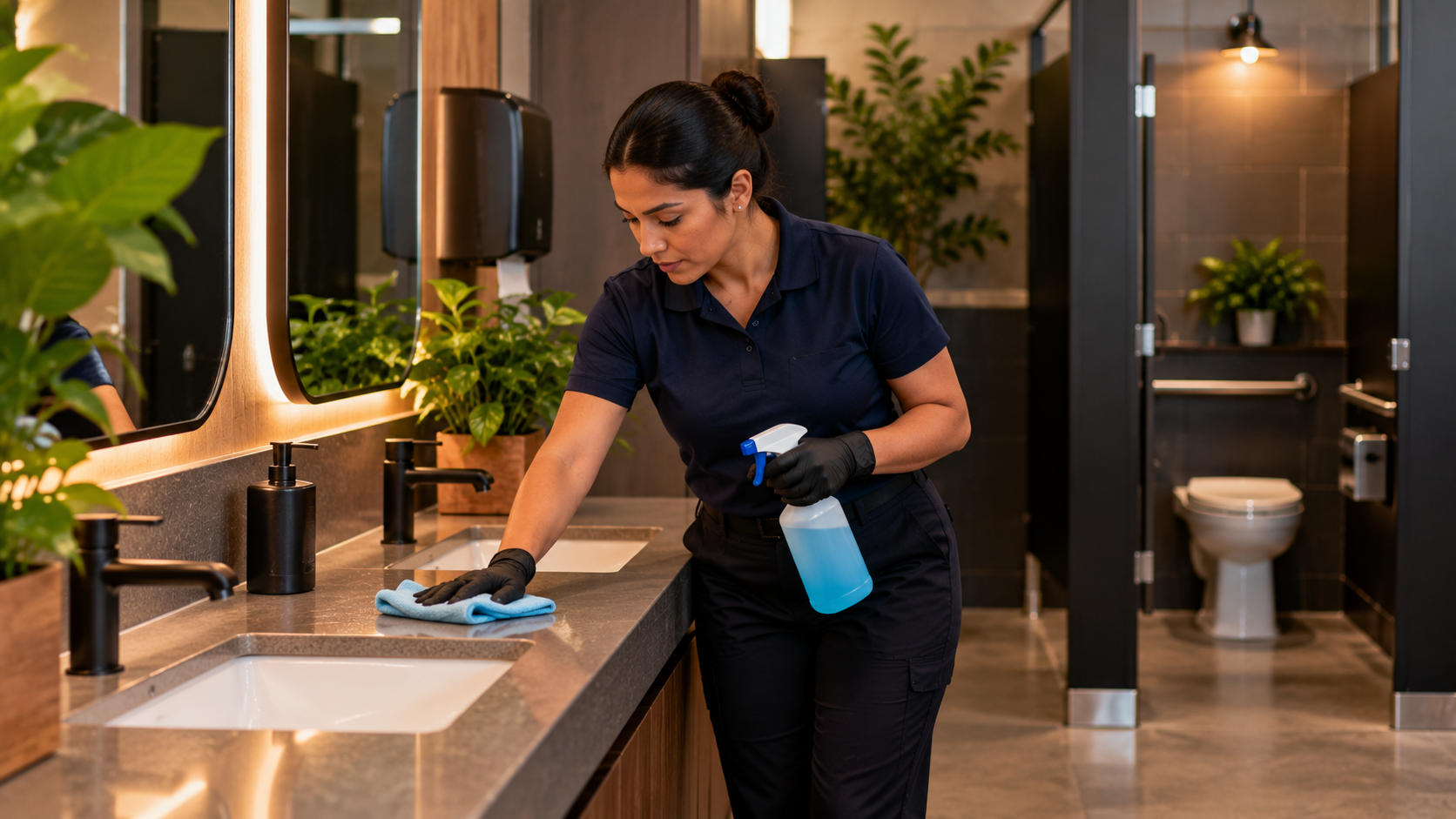
The morning rush runs through one small room
The first hours of a coffee shop day bring remarkable volume in a small footprint. Doors open before sunrise for commuters who need caffeine before a train, a freeway, or an early shift. Students settle in with laptops. Retirees gather at their usual table. Workers on a break duck in for ten minutes of quiet. Nearly all of these people, at some point, join the informal line for a single restroom, or one of two in a larger shop.
That volume is the whole story. A restroom in a home might be used a handful of times before anyone thinks about its condition. A coffee shop restroom on a busy morning can be used dozens of times before ten o clock, by strangers with no reason to treat the space gently. Paper misses the trash can. Water spreads across the sink and floor. The door handle, the lock, and the faucet collect the fingerprints of the entire morning. None of this reflects badly on any one guest. It reflects the arithmetic of hundreds of people sharing a room designed for one person at a time. The problem is that the hundredth guest judges the room as if the shop had left it that way for her personally, because from where she stands, it did.
Baristas cannot be in two places at once
Behind the counter, the morning does not pause. Drinks stack up, milk steams, timers sound, and a line forms that expects both speed and a smile. The people who make a coffee shop run are chosen for their skill at exactly that work, and during the rush every hand is spoken for.
That is when the restroom begins its quiet decline, not because anyone decided to neglect it, but because success creates a competing demand that always wins in the moment. A barista cannot
abandon a line of waiting customers, and a manager handling a delivery cannot be elsewhere either. The restroom slips in the background while the foreground work demands everything the team has. Owners often describe this as a staffing puzzle, but from the guest side of the door it does not look like a puzzle. It looks like a choice. A guest who finds paper across the floor and an overflowing trash can thinks this is the standard the shop is comfortable with, and she applies that standard to the counters, the drink station, and the food she is about to consume. The busiest hours are therefore also the hours when the shop is most at risk of losing the people who created that success.
Regulars notice patterns, not single bad moments
A first time visitor might shrug at a rough restroom and blame a busy morning. A regular cannot shrug so easily, because a regular has a memory bank. She has used that restroom twenty times. She knows whether this morning was an exception or the way things have been trending for weeks, and she is keeping score even if she would never describe it that way.
Regulars are the backbone of a neighborhood coffee shop. They come several mornings a week, often on autopilot, because the shop fits their life. Autopilot is fragile. It depends on the experience feeling reliably cared for. When a regular begins to brace herself before opening the restroom door, wondering what she will find, the ritual has already cracked. She may still come for another week or two out of habit, but the habit now competes with a small daily hesitation. Then one morning she tries the shop two blocks over, the one a coworker mentioned. Its drinks are about as good, and its restroom is noticeably better kept. No complaint gets filed and no farewell happens at the counter. She simply starts her mornings somewhere else, and the first shop loses a steady customer without ever learning why.
The restroom colors how guests judge the food and drink
There is a connection in a guest mind between the restroom and the kitchen that no menu board can overcome. Coffee shops serve food and drink that people consume on the spot, often at tables a short walk from that restroom door. Guests are not performing an inspection, but they are deciding whether this business feels careful.
If the room devoted to hygiene in its most basic form looks neglected, guests look at everything else with new eyes. The milk near the steam wand, the pastry case glass, and the self serve counter with its lids and stirrers all get reinterpreted. A shop that seemed charmingly busy can suddenly seem carelessly run. That shift is emotional rather than logical, and a guest cannot be argued out of a feeling she had in a small room at nine forty five in the morning. Online reviews follow the same pattern. Reviewers rarely write essays about espresso. They write about bathrooms. A handful of reviews mentioning a dirty restroom can define a shop for everyone searching for a place to meet a friend or work for an hour, and those readers never learn how good the coffee is.
Meeting spots and the guests who bring guests
Coffee shops are rarely just about coffee. They are where a realtor meets a client, where two founders sketch an idea, where a study group claims a table, and where a parent brings a visiting relative to show off a favorite neighborhood spot. In each moment, the host guest has put a little personal reputation on the line by choosing the place.
When that host watches a guest return from the restroom with a tight smile, the embarrassment is personal. The host apologizes for the shop as if it were her own home, and she remembers the apology the next time she chooses a meeting place. Group visits and long work sessions depend on a host feeling confident about the whole experience, not just the drinks. A restroom that embarrasses people costs a shop its role as a default gathering place, and default gathering places are where steady revenue lives. Parents feel this more sharply still. A parent helping a young child in that small room needs patience and a space that does not add stress to an awkward task, and parents talk to other parents about what they found.
Ten o clock is a mirror, not a moment
It would be comforting to treat a bad restroom morning as bad luck that will not repeat. Owners who pay attention know better. Ten in the morning happens every day. The rush is not a surprise, the volume is not a surprise, and the state of that room at midmorning is one of the most predictable facts in the business. It is a mirror held up daily, showing whether the shop systems match its ambitions.
That mirror is why the restroom deserves to be thought of as its own responsibility, not as an afterthought squeezed between drink orders. The shops regulars describe as their place, the ones with lines out the door and names remembered at the counter, tend to be the shops where that small room never becomes the story. Guests leave talking about the coffee, the people, and the morning they had, which is exactly the conversation a coffee shop wants to be part of.
Sources: https://www.fda.gov/food/fda-food-code/food-code-2022, https://www.cdc.gov/restaurant-food-safety/php/publications/handwashing-study.html, https://www.sba.gov/business-guide/plan-your-business/launch-your-business
Paradigm Janitorial | Commercial & Residential Cleaning | paradigmjanitorial.net