Your Warehouse Team Judges Your Company in the Break Room and the Restrooms
Warehouse break rooms and restrooms influence how employees experience a workplace because every shift depends on them, even when visitors never see them. Shared appliances, eating tables, waste containers, and restroom supplies can receive repeated use throughout an operating day. Keeping these rooms usable requires attention to the people using them across shifts, rather than judging their condition only during office hours.
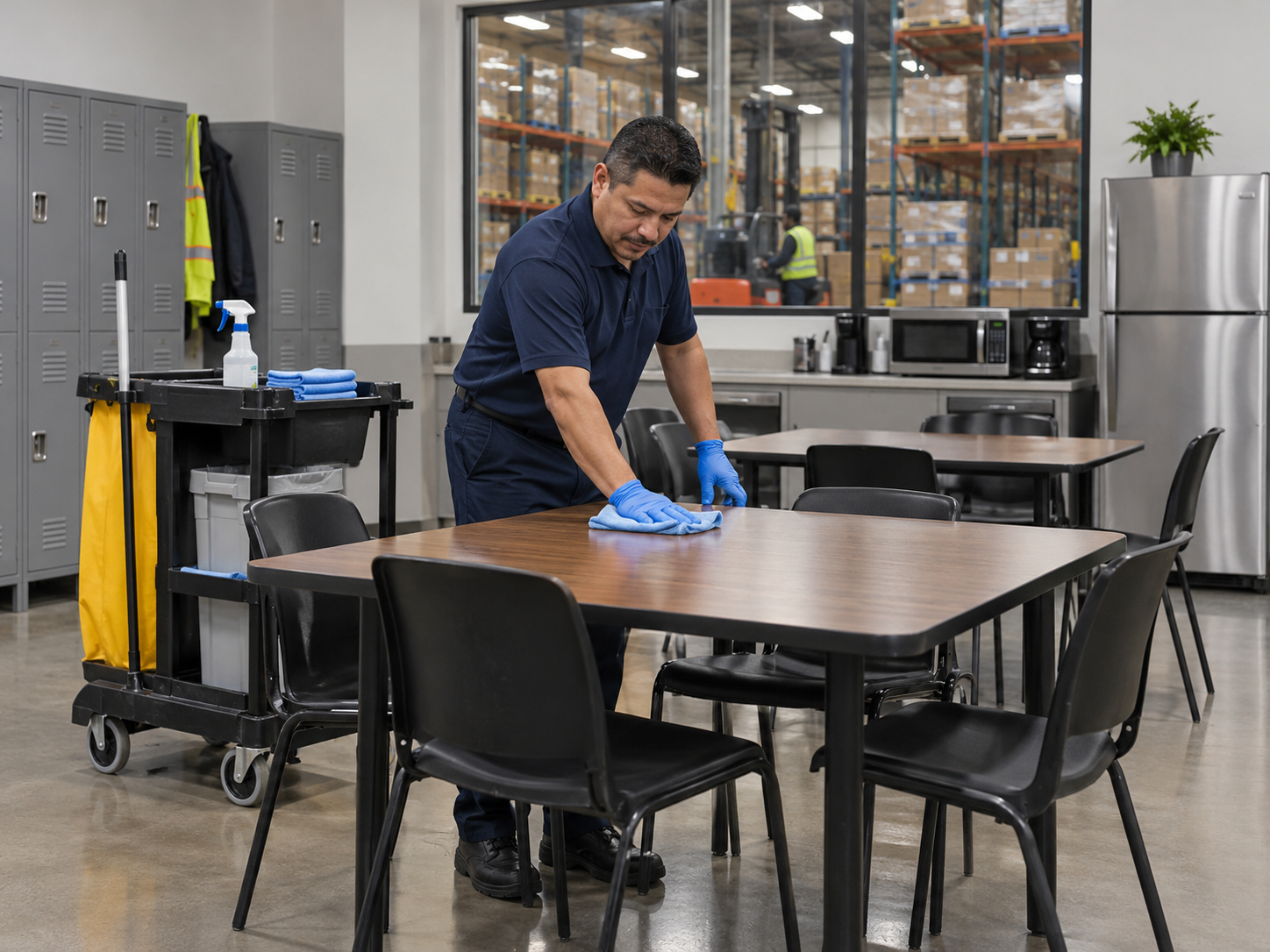
A warehouse can have an orderly reception area while employees encounter a very different standard during their breaks. That gap does not automatically explain staffing problems, but it is a visible part of daily working conditions. Unlike a meeting room that someone can book another time, the crew break room and restrooms may have few practical alternatives.
A shift change also changes the condition of shared rooms
The people beginning a shift inherit more than the work waiting on the warehouse floor. They also inherit the condition of the spaces used by the previous crew. A break room that was presentable early in the morning may have served several rounds of meals by evening.
This is not necessarily evidence that one group is careless. The room may simply serve more people than the cleaning arrangement anticipates. A microwave used throughout the day, tables occupied during overlapping breaks, and waste containers near food areas all receive repeated attention from employees without necessarily receiving repeated attention from a cleaning team.
For management, the important comparison is between shifts. A clean room during a daytime visit does not establish what the overnight crew experiences. Reviewing the actual operating hours gives a more accurate picture than treating the room as an extension of the front office.
Appliance interiors can fall between responsibilities
Shared appliances illustrate how easily assumptions develop. Employees may expect routine cleaning to include the refrigerator and microwave interiors. The cleaning agreement may address exterior surfaces only. Management may assume employees handle anything connected with their own food.
Those are different responsibilities, and each can leave a gap if it remains unspoken. An unnamed container in a refrigerator is not the same task as cleaning its handle. Clearing personal food, deciding what can be discarded, and cleaning the appliance interior should not be treated as interchangeable duties.
The same distinction applies to lockers, personal belongings, and items left on tables. A clearly understood scope protects employees' property and makes it easier to determine whether an area was overlooked or simply outside the agreed work.
Restroom condition includes supplies and availability
A restroom can have clean fixtures and still fail employees if dispensers are empty or essential items are unavailable. It can also need attention shortly after a large group uses it, even if it was cleaned earlier that day.
These issues are easy to miss during a quiet walkthrough. Employees use the rooms when their breaks and tasks allow, so their experience may differ from a manager's brief visit. Feedback from several shifts can help identify patterns that one inspection would not reveal.
Recurring problems also need the right owner. A persistent leak, damaged dispenser, blocked fixture, or ventilation problem may require maintenance. Repeatedly treating a building issue as a cleaning failure can leave the actual problem unresolved and create frustration for everyone involved.
Research supports taking the employee experience seriously
In October 2026, Cleaning and Maintenance Management reported results from a survey of 1,000 full time United States workers who spend at least three days a week in a physical workplace. Restrooms were the most frequently selected dirtiest area, named by 29 percent of respondents. Shared microwaves and other break room appliances followed at 19 percent.
The reporting also said 69 percent of respondents indicated that workplace cleanliness would affect whether they stayed at or left a job. That is a stated attitude from a general workplace survey, not evidence that 69 percent of warehouse workers will resign because of a dirty room. It does, however, support treating cleanliness as part of the employee experience rather than a concern reserved for visiting customers.
The study was commissioned by a cleaning company, another reason to present it with its context. It helps illustrate what respondents said they notice, while the conditions in a particular warehouse still need to be assessed directly.
Ordinary soil and specialized industrial work are different
Warehouse employees may bring ordinary dust and debris from surrounding work areas into shared rooms. The amount depends on the building, the work performed, and the routes people use. A distribution warehouse should not automatically be described as if it has the same cleaning needs as a manufacturing facility.
That distinction matters when deciding what belongs in a janitorial arrangement. Employee rooms and ordinary shared surfaces are one area of work. Production equipment, industrial residues, and materials that require specialized handling are another. Neither management nor a service provider should assume that a general cleaning scope covers every condition on an industrial property.
A clear description of the facility helps the right people address the right tasks. It also keeps an article about employee spaces from making promises about technical work that has not been discussed.
Consistency matters more than a polished inspection day
A useful standard is one that employees recognize throughout the operating week. The aim is not to prepare a room for a single visit and then leave later shifts to manage the difference. It is to have an arrangement that reflects room use, access, supplies, and the boundaries between cleaning and maintenance.
That does not require management to assume every complaint is a staffing issue or every departure is caused by the building. It means taking a recurring, visible part of the workday seriously. Employees should be able to use shared rooms without regularly working around avoidable mess or unavailable supplies.
Paradigm Janitorial can discuss warehouse employee area cleaning in Los Angeles County and San Bernardino County. A useful starting point is the building's operating pattern, so the conversation includes the crews using these rooms outside the hours when the front office is busiest.
Resources
Cleaning and Maintenance Management, Workers Most Often Identify Restrooms as the Dirtiest Area
October 6, 2026 reporting on a commissioned workplace survey, including its sample and respondents' views about shared spaces. The findings are not specific to Paradigm clients or to local warehouses.
CDC, When and How to Clean and Disinfect a Facility
General community facility guidance. Specialized industrial settings and food handling areas may require additional practices beyond this resource.