
Understanding Cloudy Residue on Newly Installed Tile
Cloudy patches on newly installed tile can be grout residue, but a similar appearance can also come from another surface film or damage. Ordinary mopping may not remove the residue because the appropriate treatment depends on the tile, grout and finish. Identify those materials with the installer before trying stronger cleaners, and test any approved treatment in a small inconspicuous area.
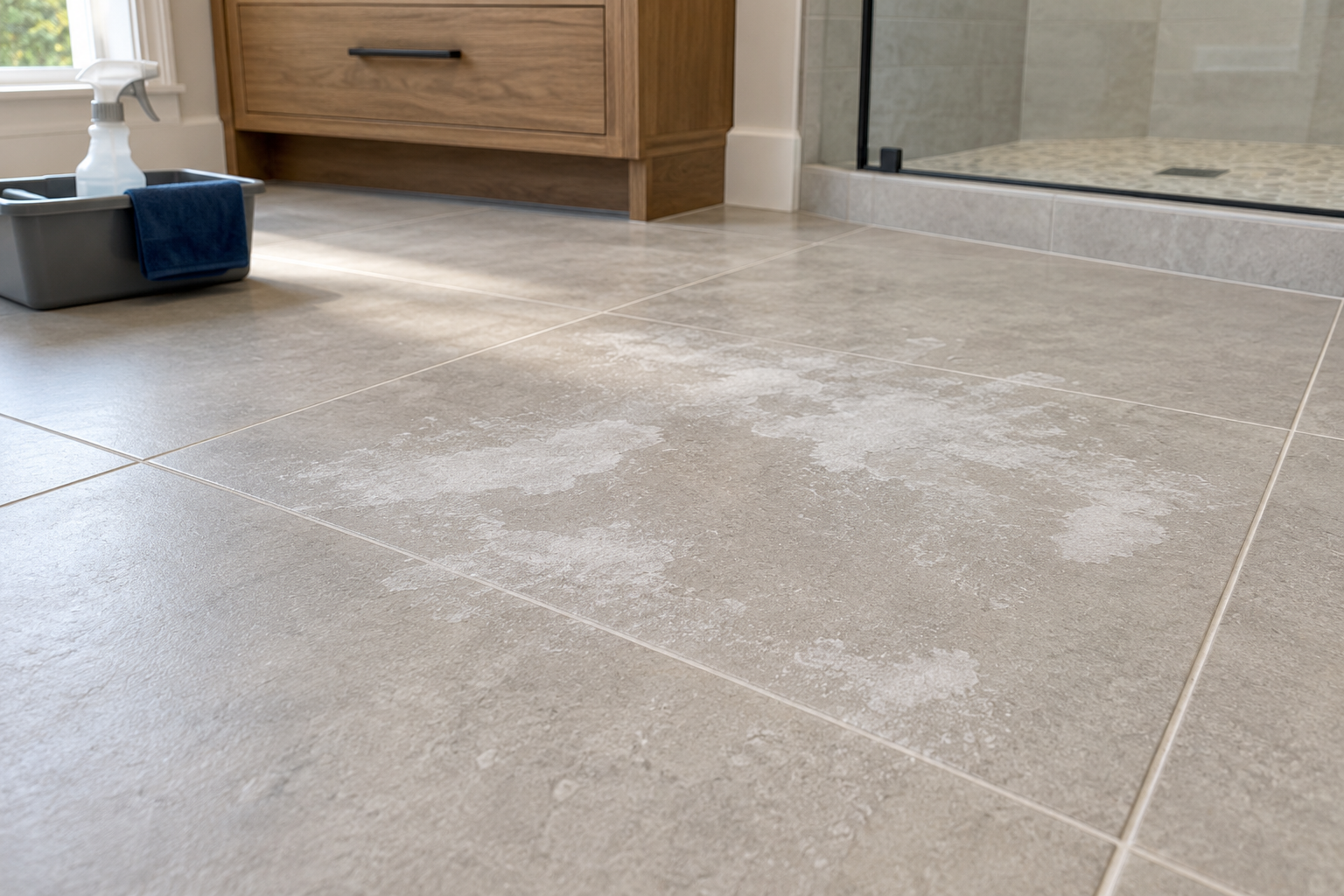
Start with the installation details, not another bottle of cleaner
Ask the installer for the tile product name, grout brand and product, installation date and any sealer or protective treatment used. Keep photographs of the floor when it is completely dry. Record the products that have already been applied and whether the cloudy appearance changed. Those details help the installer or manufacturer distinguish a cleanup issue from a finish problem.
Describe where the marks occur. Are they spread across the tile faces, concentrated near joints or visible along the path where cleaning started? Do they look the same under daylight and room lighting? These observations are useful evidence, but they do not establish the cause on their own. A photograph cannot reliably identify every residue or show whether a finish has been altered.
Why ordinary mopping can leave the haze behind
MAPEI describes grout haze as material left on tile or stone after grouting. It can look powdery, cloudy, streaked or glossy. The company explains that different grout formulations require different cleanup approaches. A product intended for one residue may not be suitable for another, even if both floors look similarly cloudy.
Routine floor cleaning and installation residue removal are different assignments. A cleaner hired to remove everyday dust may not have the material information or specialty treatment required for a cured film. Tell the provider that the floor is newly installed and that the appearance remained after routine cleaning. Include the installation records when requesting an assessment.
Protect the surrounding materials as well as the tile
A floor is more than its tile faces. Grout, metal fixtures, stone thresholds, cabinetry and neighboring surfaces may respond differently to a cleaner. Do not assume that a product appropriate for porcelain is appropriate for every material nearby. Ask for a plan that accounts for those surfaces and follows the relevant product instructions.
Avoid jumping from one chemical to another or using an aggressive abrasive to force a result. MAPEI cautions that acidic cleaners must be limited to compatible surfaces and can damage materials such as marble. The right question is whether a treatment is approved for this particular assembly, not whether it is stronger than the last product.
What a useful test area should establish
Ask the installer or qualified cleaning provider to choose a small inconspicuous area and identify the proposed product and method. Document the appearance before treatment and again when the test area is dry. Agree on what a satisfactory result would look like before treating the whole floor. A wet surface can temporarily hide an appearance problem.
The test should also check for an unwanted change in color, gloss or texture. If the approved treatment does not produce the expected improvement, stop and return to the material information. Repeating an unsuccessful process throughout the room makes the problem larger without clarifying its cause.
When cleaning is the right next step
If the installer or manufacturer identifies removable residue and specifies an appropriate method, specialty cleaning may be the next step. Confirm the work area, access, protection of nearby finishes and how the result will be reviewed. Keep the records with the renovation paperwork so future cleaners know what was applied to the floor.
If there is no confirmed residue, or the appearance remains after an appropriate test, ask the installer or manufacturer to assess the finish. Cleaning cannot restore every damaged surface. You do not need to assume the tile must be replaced, but you should not accept a promise that every cloudy patch can be scrubbed away. Start with a documented assessment and a controlled test, then decide whether the job is cleaning, repair or an installation concern.
Resources
- MAPEI, understanding grout haze
Manufacturer guidance on different grout residues, compatible products and test areas.
- Natural Stone Institute, care and cleaning
Material identification and care guidance for stone surfaces near the work area.